Tuesday, May 29, 2018

Hot Energy Stocks To Invest In 2018

tags:IO,NOG,OII,ENSV,PDCE,NFX, President Trump chose a dicey time to crack down on Iran, the world's fifth-biggest oil producer.

Global oil supplies were already getting tight before Trump vowed on Tuesday to exit the Iran nuclear deal and impose "powerful" sanctions on the OPEC nation.

Energy industry insiders say Trump's tough stance on Iran will probably keep oil and gasoline prices higher than they would otherwise be.

Iran ramped up its oil production by 1 million barrels per day after sanctions were lifted in early 2016. At least some of that oil will now be pulled from the market �� at a time when oil prices are already rising because of production cuts by OPEC and Russia as well as instability in Venezuela.

Dan Eberhart, CEO of oilfield services company Canary LLC, drew a direct connection: "Withdrawing from the Iran nuclear deal will support higher oil prices."

Trump telegraphed the move, and oil prices shot up in recent weeks as traders anticipated it. Crude topped $70 a barrel this week for the first time in nearly four years. Hours before Trump's announcement, federal government forecasters raised their estimate for 2018 oil prices by 10.5% to an average of $65.58 a barrel.

Hot Energy Stocks To Invest In 2018: Ion Geophysical Corporation(IO)

Advisors' Opinion:
  • [By Ethan Ryder]

    Ion Geophysical Corp (NYSE:IO) was the recipient of unusually large options trading on Thursday. Traders bought 1,224 call options on the company. This represents an increase of approximately 1,230% compared to the typical volume of 92 call options.

  • [By Max Byerly]

    ION Geophysical (NYSE: IO) and Glencore (OTCMKTS:GLNCY) are both oils/energy companies, but which is the superior business? We will contrast the two businesses based on the strength of their risk, valuation, dividends, profitability, institutional ownership, earnings and analyst recommendations.

Hot Energy Stocks To Invest In 2018: Northern Oil and Gas, Inc.(NOG)

Advisors' Opinion:
  • [By Matthew DiLallo]

    Shares of Northern Oil & Gas, Inc. (NYSEMKT:NOG) are flying high, up 12% as of 10:30 a.m. EDT, after the company reported better-than-expected first-quarter results.

  • [By Ezra Schwarzbaum]

    SunTrust analyst Neal Dingmann upgraded shares of Northern Oil & Gas, Inc. (NYSE: NOG) from Hold to Buy and increased his price target from $2 to $4.

  • [By Ethan Ryder]

    Northern Oil and Gas Inc. (NYSEAMERICAN:NOG) has received a consensus recommendation of “Hold” from the eight research firms that are presently covering the firm, MarketBeat.com reports. Seven investment analysts have rated the stock with a hold rating and one has issued a buy rating on the company. The average 12 month price target among brokers that have covered the stock in the last year is $2.20.

Hot Energy Stocks To Invest In 2018: Oceaneering International, Inc.(OII)

Advisors' Opinion:
  • [By Todd Campbell]

    I've�written previously�about my belief that shrinking oil inventories and rising crude oil prices will spark a recovery in energy services stocks, and I've already explained why Core Labs�and Hess Corp are favorite stocks of mine to buy. Now, after reviewing�Oceaneering International's (NYSE:OII) first-quarter results,�I'm increasingly convinced that it's a great time to add this stock to any portfolio.

  • [By Joseph Griffin]

    Get a free copy of the Zacks research report on Oceaneering International (OII)

    For more information about research offerings from Zacks Investment Research, visit Zacks.com

  • [By Ethan Ryder]

    Oceaneering International (NYSE:OII) was the recipient of some unusual options trading activity on Monday. Stock traders purchased 833 put options on the stock. This is an increase of approximately 1,415% compared to the average daily volume of 55 put options.

  • [By Logan Wallace]

    Cypress Energy Partners (NYSE: CELP) and Oceaneering International (NYSE:OII) are both oils/energy companies, but which is the superior business? We will contrast the two companies based on the strength of their dividends, analyst recommendations, risk, valuation, institutional ownership, earnings and profitability.

  • [By Matthew DiLallo]

    Oceaneering International (NYSE:OII) warned investors earlier this year that 2018 would be a challenging one. The offshore service and product company also thought that the first quarter would be particularly tough because it's a seasonally weaker quarter. While it�didn't go exactly as the company envisioned, the results met its muted expectations overall.

Hot Energy Stocks To Invest In 2018: ENSERVCO Corporation(ENSV)

Advisors' Opinion:
  • [By Logan Wallace]

    Enservco (NYSEAMERICAN:ENSV) will be issuing its quarterly earnings data before the market opens on Wednesday, May 9th.

    Enservco (NYSEAMERICAN:ENSV) last issued its earnings results on Thursday, March 22nd. The oil and gas producer reported ($0.04) earnings per share for the quarter, missing the Zacks’ consensus estimate of ($0.01) by ($0.03). Enservco had a negative return on equity of 89.94% and a negative net margin of 43.71%. The business had revenue of $14.13 million during the quarter.

Hot Energy Stocks To Invest In 2018: PDC Energy, Inc.(PDCE)

Advisors' Opinion:
  • [By Max Byerly]

    Get a free copy of the Zacks research report on PDC Energy (PDCE)

    For more information about research offerings from Zacks Investment Research, visit Zacks.com

Hot Energy Stocks To Invest In 2018: Newfield Exploration Company(NFX)

Advisors' Opinion:
  • [By Chris Lange]

    The S&P 500 stock posting the largest daily percentage loss ahead of the close Tuesday was Newfield Exploration Company (NYSE: NFX) which traded down nearly 5% at $23.22. The stock��s 52-week range is $22.96 to $37.61. Volume was 5.2 million compared to the daily average volume of 3.3 million.

  • [By VantagePoint]

    Newfield Exploration Company (NYSE: NFX) just had a bearish crossover on Friday, according to the chart. The predicted 72-hour moving average crossed below the simple 10-day moving average. If Monday's price action holds, that will serve as a confirmation the negative trend. 

  • [By Ethan Ryder]

    Fernwood Investment Management LLC trimmed its stake in Newfield Exploration (NYSE:NFX) by 6.0% in the first quarter, according to the company in its most recent disclosure with the Securities & Exchange Commission. The fund owned 31,500 shares of the energy company’s stock after selling 2,000 shares during the quarter. Fernwood Investment Management LLC’s holdings in Newfield Exploration were worth $769,000 at the end of the most recent quarter.

Monday, May 28, 2018

Key Square Capital Management LLC Takes $9.97 Million Position in Bright Horizons Family Solutions (

Key Square Capital Management LLC bought a new stake in shares of Bright Horizons Family Solutions (NYSE:BFAM) in the 1st quarter, according to its most recent disclosure with the Securities and Exchange Commission. The fund bought 100,000 shares of the company’s stock, valued at approximately $9,972,000. Bright Horizons Family Solutions makes up about 1.1% of Key Square Capital Management LLC’s investment portfolio, making the stock its 21st biggest position.

Other large investors have also recently bought and sold shares of the company. Quadrature Capital Ltd purchased a new position in shares of Bright Horizons Family Solutions during the 4th quarter valued at approximately $567,000. LPL Financial LLC increased its holdings in shares of Bright Horizons Family Solutions by 22.2% during the 4th quarter. LPL Financial LLC now owns 10,335 shares of the company’s stock valued at $971,000 after purchasing an additional 1,880 shares in the last quarter. Carillon Tower Advisers Inc. purchased a new position in shares of Bright Horizons Family Solutions during the 4th quarter valued at approximately $47,584,000. Invictus RG purchased a new position in shares of Bright Horizons Family Solutions during the 4th quarter valued at approximately $402,000. Finally, Schwab Charles Investment Management Inc. increased its holdings in shares of Bright Horizons Family Solutions by 11.4% during the 4th quarter. Schwab Charles Investment Management Inc. now owns 290,698 shares of the company’s stock valued at $27,326,000 after purchasing an additional 29,775 shares in the last quarter. 98.49% of the stock is owned by hedge funds and other institutional investors.

Get Bright Horizons Family Solutions alerts:

In other Bright Horizons Family Solutions news, CEO Stephen Howard Kramer sold 2,961 shares of Bright Horizons Family Solutions stock in a transaction on Thursday, March 15th. The shares were sold at an average price of $99.61, for a total transaction of $294,945.21. The sale was disclosed in a legal filing with the SEC, which is accessible through the SEC website. Also, CFO Elizabeth J. Boland sold 6,000 shares of Bright Horizons Family Solutions stock in a transaction on Thursday, May 17th. The stock was sold at an average price of $99.09, for a total transaction of $594,540.00. Following the sale, the chief financial officer now directly owns 140,113 shares in the company, valued at approximately $13,883,797.17. The disclosure for this sale can be found here. Insiders sold a total of 157,613 shares of company stock worth $15,981,201 in the last three months. 2.20% of the stock is owned by corporate insiders.

Bright Horizons Family Solutions opened at $101.04 on Friday, Marketbeat Ratings reports. Bright Horizons Family Solutions has a 1 year low of $75.55 and a 1 year high of $105.04. The firm has a market capitalization of $5.85 billion, a P/E ratio of 39.62, a P/E/G ratio of 2.28 and a beta of 0.09. The company has a debt-to-equity ratio of 1.42, a quick ratio of 0.38 and a current ratio of 0.38.

Bright Horizons Family Solutions (NYSE:BFAM) last released its quarterly earnings results on Monday, April 30th. The company reported $0.72 earnings per share (EPS) for the quarter, beating analysts’ consensus estimates of $0.71 by $0.01. Bright Horizons Family Solutions had a net margin of 8.58% and a return on equity of 21.28%. The firm had revenue of $463.66 million for the quarter, compared to analysts’ expectations of $461.15 million. During the same quarter last year, the company earned $0.61 EPS. The firm’s revenue for the quarter was up 9.8% compared to the same quarter last year. analysts forecast that Bright Horizons Family Solutions will post 2.96 EPS for the current year.

BFAM has been the subject of several recent research reports. Goldman Sachs Group initiated coverage on shares of Bright Horizons Family Solutions in a report on Tuesday, March 27th. They set a “neutral” rating and a $104.00 target price for the company. Credit Suisse Group lifted their target price on shares of Bright Horizons Family Solutions from $90.00 to $98.00 and gave the company a “neutral” rating in a report on Friday, February 9th. ValuEngine raised shares of Bright Horizons Family Solutions from a “hold” rating to a “buy” rating in a report on Monday, April 2nd. BMO Capital Markets cut their target price on shares of Bright Horizons Family Solutions from $107.00 to $105.00 and set a “market perform” rating for the company in a report on Tuesday, May 1st. Finally, Zacks Investment Research lowered shares of Bright Horizons Family Solutions from a “buy” rating to a “hold” rating in a report on Monday, April 2nd. Six investment analysts have rated the stock with a hold rating and seven have given a buy rating to the company. The company currently has a consensus rating of “Buy” and an average price target of $103.73.

About Bright Horizons Family Solutions

Bright Horizons Family Solutions Inc provides child care and early education, back-up dependent care, and educational advisory services for employers and families. The company operates through three segments: Full Service Center-Based Child Care, Back-Up Dependent Care, and Other Educational Advisory Services.

Want to see what other hedge funds are holding BFAM? Visit HoldingsChannel.com to get the latest 13F filings and insider trades for Bright Horizons Family Solutions (NYSE:BFAM).

Institutional Ownership by Quarter for Bright Horizons Family Solutions (NYSE:BFAM)

Saturday, May 26, 2018

Diversified Restaurant (SAUC) Sets New 1-Year High and Low at $1.15

Diversified Restaurant Holdings Inc. (NASDAQ:SAUC) shares hit a new 52-week high and low during mid-day trading on Thursday . The company traded as low as $1.15 and last traded at $1.16, with a volume of 422 shares changing hands. The stock had previously closed at $1.20.
Separately, Zacks Investment Research upgraded shares of Diversified Restaurant from a “sell” rating to a “hold” rating in a report on Friday, May 11th.

Get Diversified Restaurant alerts:

The company has a debt-to-equity ratio of -4.53, a quick ratio of 0.25 and a current ratio of 0.33.

Diversified Restaurant (NASDAQ:SAUC) last released its quarterly earnings results on Wednesday, May 9th. The restaurant operator reported $0.01 earnings per share for the quarter, missing the Thomson Reuters’ consensus estimate of $0.03 by ($0.02). The company had revenue of $39.53 million during the quarter. Diversified Restaurant had a negative net margin of 13.13% and a negative return on equity of 4.31%.

An institutional investor recently raised its position in Diversified Restaurant stock. Poehling Capital Management LLC grew its stake in Diversified Restaurant Holdings Inc. (NASDAQ:SAUC) by 9.0% in the 1st quarter, according to its most recent disclosure with the Securities & Exchange Commission. The firm owned 814,825 shares of the restaurant operator’s stock after buying an additional 67,241 shares during the quarter. Poehling Capital Management LLC owned 3.03% of Diversified Restaurant worth $1,100,000 at the end of the most recent reporting period. Hedge funds and other institutional investors own 10.66% of the company’s stock.

Diversified Restaurant Company Profile

Diversified Restaurant Holdings, Inc (DRH) is a restaurant company. The Company is a franchisee of Buffalo Wild Wings (BWW).As of September 25, 2016, the Company operated 64 BWW restaurants, which are located in Michigan, Florida, Missouri, Illinois and Indiana. The BWW restaurants feature a range of menu items with a multimedia social environment, a bar and an open layout designed to create a dining experience for sports fans and families.

Friday, May 25, 2018

BJ's Wholesale Club Files For IPO

Quick Take

BJ��s Wholesale Club (BJ) intends to sell shares of its common stock for gross proceeds of $100 million from a U.S. IPO, according to an S-1 registration statement.

The firm serves as a warehouse club operator on the East Coast of the U.S. The company offers perishable products, general merchandise, gas and other ancillary services.

BJ��s is continuing to expand its footprint and is investing in online ordering and delivery capabilities to compete better, but its financial results have been uneven and growth lackluster.

I��ll provide an update when we learn the IPO details.

Company & Technology

Westborough, MA-based BJ��s Wholesale Club was founded in 1984 as a warehouse club channel in the U.S. The company offers discounted prices and a selection of SKUs and services in a warehouse format.

Management is headed by President and CEO Chris Baldwin, who has been with the firm since 2015. Baldwin was previously the CEO of Hess Retail Corporation from 2013-2015 and SVP Marketing and Refining of the same company from 2010 - 2013. Baldwin also served as President (Snacks) of Kraft Foods Group from 2007 - 2010.

BJ��s target market includes price-sensitive customers with large household sizes within the United States. The company targets households with an average annual income of approximately $75,000.

5% or greater shareholders in the firm include CVC Beacon and Green Equity Investors. CVC is a fund of CVC Capital Partners, a large UK-based private equity firm that along with Green Equity took BJ��s private in mid-2011 for approximately $2.8 billion.

BJ��s is based on a warehouse club model that sets it apart from other retail formats. The company offers membership fee subscriptions and limited and bulk sized-SKUs. It pursues low operating costs from low club labor requirements, efficient distribution, and high inventory turnover.

Below is a brief overview video of the services/products that the company offers:

(Source: BJ��s Wholesale Club)

The company operates 215 clubs in the Eastern United States. BJ��s has five million paid memberships. Membership options include Inner Circle memberships which cost $55 annually and BJ��s Perks Rewards memberships which cost $110 annually.

(Source: S-1 statement)

Members of the clubs are able to shop in-stores, the website, and mobile app. Instacart same-day delivery is offered for the online options. The company has two private label brands, Wellsley Farms庐 and Berkley Jensen庐. These brands represent over $2 billion in sales and are the company��s largest brands.

BJ��s claims to offer 25% or more savings on a basket of manufacturer-branded groceries compared to typical supermarket competitors.

Customer Acquisition

Customer acquisition for the company is accomplished through channels such as social media, public relations, direct mail, public relations efforts, radio advertising, community involvement, new club marketing programs and various publications.

In addition, marketing staff contacts potential business members and other selected organizations. BJ��s also offers free promotional membership and initially discounted membership promotions to generate awareness and attract new customers.

Management is confident that the company is well-positioned to continue taking market share due to a growing consumer focus on value, driven by such factors as the growth of ecommerce, an increase in price transparency and demographic trends.

BJ��s cost of revenue for the past three years has slightly decreased to 82%:

FYE 2018: 82% FYE 2017: 82% FYE 2016: 84%

Selling and G&A costs as a percentage of total revenue have been trending upward, indicating less efficiency over the period:

FYE 2018: 15.7% FYE 2017: 15.4% FYE 2016: 14.4% Market & Competition

According to a 2017 market research report by IBISWorld, the Warehouse Clubs and Supercenters Industry generates $457 billion in revenue and experienced an annual growth of 0.8% from 2012 - 2017.

The main factors driving forecasted market growth are increased per capita disposable income and corporate profit. During the next five years industry revenue is predicted to rise with the improving economy.

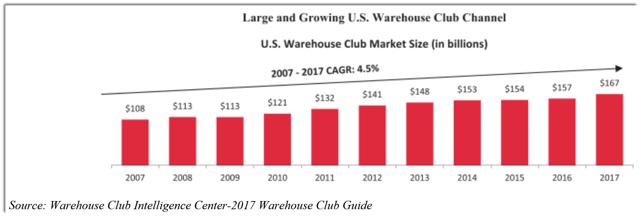
Below is a U.S. warehouse club growth history graphic, 2007 - 2017:

(Source: S-1)

Major competitive vendors within this industry include:

Amazon (AMZN) Costco Wholesale (COST) Walmart Stores (WMT) Other grocery chains and stores

Management of the company believes that a differentiated shopping experience, well-positioned footprint and flexible new club model, large and loyal membership base, attractive strong free cash flow across economic cycles, and an experienced management team are competitive strengths of BJ��s.

Financial Performance

BJ��s recent financial results can be summarized as follows:

Uneven topline revenue growth Increasing gross profit Steadily increasing gross margin Uneven cash flow

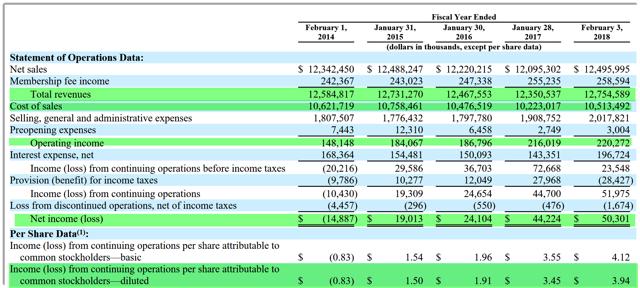
Below are the company��s financial results for the past five years (Audited GAAP for full years):

(Source: S-1 statement)

Total Revenue ($)

FYE 2018: $12.8 billion, 3% increase vs. prior FYE 2017: $12.4 billion, 0.8% decrease vs. prior FYE 2016: $12.5 billion

Gross Profit ($)

FYE 2018: $2.2 billion FYE 2017: $2.1 billion FYE 2016: $2.0 billion

Gross Margin (%)

FYE 2018: 17.6% FYE 2017: 17.2% FYE 2016: 16.0%

Cash Flow from Operations ($)

FYE 2018: $210.1 million FYE 2017: $297.4 million FYE 2016: $159.4 million

As of February 3, 2018, the company had $35.0 million in cash and $3.57 billion in total liabilities.

IPO Details

BJ��s Whole Club intends to raise $100 million in gross proceeds from an IPO of its common stock.

Management says it will use the net proceeds from the IPO as follows:

We intend to use the net proceeds from this offering, together with cash and borrowings under the ABL Facility, to repay ... indebtedness plus�� accrued and unpaid interest and prepayment premium under the Second Lien Facility. To the extent any proceeds from this offering remain after the repayment in full of our Second Lien Facility, including any accrued and unpaid interest and prepayment premium thereon, we intend to use such remaining proceeds for general corporate purposes.

Management��s presentation of the company roadshow isn��t available yet.

Listed bookrunners of the IPO are BofA Merrill Lynch, Deutsche Bank Securities, Goldman Sachs & Co. and J.P. Morgan.

Expected IPO Pricing Date: Not on calendar.

An enhanced version of this article on my Seeking Alpha Marketplace research service IPO Edge includes my commentary and opinion on the firm's IPO prospects.

Members of IPO Edge get the latest IPO research, news, market trends and industry analysis. Start with a Free Trial.

Disclosure: I/we have no positions in any stocks mentioned, and no plans to initiate any positions within the next 72 hours.

I wrote this article myself, and it expresses my own opinions. I am not receiving compensation for it (other than from Seeking Alpha). I have no business relationship with any company whose stock is mentioned in this article.

Wednesday, May 23, 2018

Tiny but mighty, small US companies are beating bigger rivals

Size may be overrated when it comes to US stocks, because investors clearly prefer small companies over big ones this year.

That's a sign of the continued strength of America's economy.

The Russell 2000 (RUT), an index that includes shares of mostly smaller US companies, is up nearly 7% this year and is trading at an all-time high.

Contrast that with the Dow and S&P 500, both of which are home for industry giants like Apple (AAPL), Disney (DIS), Coca-Cola (KO) and Boeing (BA). They are up just 1% and 2% respectively -- and they are each still trading about 5% below their record highs.

Why are smaller companies outperforming the stocks of more well-known firms that make headlines day in and day out?

To start, many smaller businesses in the Russell 2000 are growing their profits at a faster rate than the giants of the Dow and S&P 500.

Earnings for the Russell 2000 companies are expected to increase more than 40% this year and another 23% in 2019. That's much better than analysts' forecasts of a 20% jump in earnings for S&P 500 companies this year and 10% next year.

Mark Hackett, chief of investment research for Nationwide, said that President Donald Trump's tax cut and deregulation policies favor smaller, domestic oriented companies over large, multinational blue chips.

Hackett also notes that smaller companies in the Russell 2000 benefit more from a solid US economy because they have more exposure to America than their larger rivals.

Coke, for example, generates nearly 60% of its revenue from outside America.

But tiny rival National Beverage (FIZZ), the maker of LaCroix, gets nearly all its $827 million in annual sales from the United States. National Beverage is in the Russell 2000 and its stock has done much better than Coke and Pepsi (PEP) over the past few years.

Another factor in the favor of smaller companies is they historically have paid higher tax rates than bigger companies, because they don't spend as much on capital investments as larger firms.

That means the recent corporate tax cuts should help Russell 2000 companies more than big firms in the S&P 500.

Dave Harden, president and chief investment officer with Summit Global Investments, notes that smaller companies have been safer investments lately because they aren't as subject to whims in the broader market.

They aren't going to get hurt on the latest headlines about US-China trade talks or worries about sluggish global growth, for example.

"A lot of large caps stumbled earlier this year and there has been volatility. People are looking to small caps. There are just more opportunities," Harden said.

Harden said investors looking at smaller companies shouldn't just focus on one sector either. Like any portfolio of larger stocks, it pays to be diversified.

Some of his top picks are building materials maker BMC Stock Holdings, children's book publisher Scholastic (SCHL), biotech Ligand Pharmaceuticals (LGND), World Wrestling Entertainment (WWE)and Camping World, the RV dealer run by Marcus Lemonis, who is well-known for his CNBC show "The Profit."

Craig Hodges, a portfolio manager with Hodges Funds, also thinks small companies will continue to lead the market.

He said that the Trump administration's pullback on many government regulations put into place during the Obama era will help smaller companies, since most of them don't have as much money to spend on legal and compliance issues as larger firms.

Hodges said that there could be a merger boom that lifts small stocks as well.

Part of that has to do with the fact that bigger companies are bringing back to the United States cash that they had overseas thanks to the tax law changes. Some of that cash could be used for deals.

It seems that larger companies are realizing that acquisitions could be a way to help boost profits.

Just this week, Cincinnati-based regional bank Fifth Third (FITB), a S&P 500 member worth $22 billion, said it was buying small Chicago financial firm MB Financial for $4.7 billion. MB Financial (MBFI), which is in the Russell 2000, surged nearly 13% on the news.

Tuesday, May 22, 2018

Why Qudian Inc Stock Dropped 16.5% Today

What happened

Shares of�Qudian (NYSE:QD)�closed down 16.5% on Monday after the Chinese online lender announced earnings that fell short of expectations.

Qudian reported�"diluted adjusted net income per share"�of $0.16 but�GAAP diluted net income per share of only $0.15 per share. Whichever yardstick you use, though, these numbers appear to be lower than the $0.17-per-share estimate quoted on Yahoo! Finance. Revenue, on the other hand, came in at $273.7 million, significantly above consensus expectations�for $214.6 million.

Hands holding 100 yuan bills

Image source: Getty Images.

So what

Sales more than doubled (up 106%) year over year, but earnings in local currency declined 38%. CEO Min Luo attributed the earnings disappointment to "the temporary credit downturn in Chinese consumer credit markets following implementation of new regulations late last year as well as our proactive decision to temporarily tighten credit standards and de-risk our book."

Now what

Also affecting the stock, one imagines, is a small note inserted toward the end of Qudian's earnings release that said two members of the company's board of directors have resigned. "Mr.�Shilei Li�and Mr.�Yi Cao," said the company,�"have tendered their resignations as directors to the Company's board for personal reasons." The fact that both resignations occurred "effective as of the date of this press release," however, seems rather sudden, and suggests there may be more to this story.

But Qudian isn't saying what, and investors don't seem to be inclined to stick around and find out.

Monday, May 21, 2018

Buy Mahindra & Mahindra Financial Services: Akash Jain

Akash Jain

Mahindra & Mahindra Financial Services is one of India��s leading non-banking finance companies focused in the rural and semi �� urban sector is the largest Indian tractor financier. Primarily in the business of financing purchase of new and pre-owned auto and utility vehicles, tractors, cars, commercial vehicles, construction equipments and SME Financing.

At current market price of Rs 463 (Face value: Rs 2), the stock trades at a P/BV of 3.2x which we believe is cheap as compared to other listed NBFCs. In Q4FY18, the company witnessed strong 17.8�percent YoY growth in AuM and a sharp 22�percent QoQ decline in GNPA.

The company's Q4FY18 consolidated net profit rose 79.4 percent at Rs 513.1 crore against Rs 286 crore, in the same quarter last year. The company improved its Return on Assets significantly from 1 percent in FY17 to 1.9 percent in FY18. With improving rural cash flows, recovery from NPAs would help the company to improve its ROA of 2.6-2.8�percent by FY20.